Migration from cWB
pycWB is a Python implementation of the coherent WaveBurst (cWB/cWB-2G) search algorithms, the wavelet-based pipeline for unmodeled gravitational-wave transient searches. This page explains how public cWB documentation and ROOT/C++ cWB workflows map to the current pycWB documentation.
Note
The public cWB pages describe the ROOT/C++ cWB software and commands such
as cwb_gwosc. They remain useful scientific references, but pycWB users
should follow the current pycWB commands in Start Here,
Production Analysis, and CLI Reference.
What cWB Contributed
Coherent WaveBurst searches for short gravitational-wave transients with minimal assumptions about the signal waveform. The algorithmic chain transforms detector strain data into WDM time-frequency maps, identifies coherent excess power across the detector network, builds pixel clusters and multi-resolution superclusters, and uses a coherent likelihood to distinguish astrophysical candidates from incoherent noise.
cWB has been used throughout LIGO, Virgo, and KAGRA transient analyses. The public documentation is valuable because it records examples, GWTC waveform reconstructions, CED galleries, and citation guidance that still help users understand the same algorithms that pycWB implements in Python.
Flavors of cWB
Flavor |
Role |
Relation to pycWB |
|---|---|---|
cWB-2G |
The standard coherent WaveBurst pipeline, historically implemented in ROOT/C++ and used for LVK burst searches and public GWTC reconstructions. |
pycWB implements the same search algorithms while moving the workflow, configuration, module boundaries, and postproduction tooling into a Python package. |
pycWB |
A modular Python framework for coherent burst searches, with YAML configuration, native Python/JAX/Numba modules, improved injection support, and streamlined postproduction. |
This is the software documented here: the cWB-2G algorithmic chain expressed as a modular Python workflow. Start with Start Here for a runnable example. |
cWB-XP |
A separate cWB branch. It keeps the ROOT/C++ framework but changes the core transform/statistic by using a multi-resolution WaveScan transform and a cross-power statistic. |
It is useful comparison context, but it is not pycWB and is not covered by the pycWB user guide. |
Public Examples
GW150914
GW150914 was the first gravitational-wave event. The public cWB material notes that the low-latency cWB search identified the event and preserves public time-frequency displays and CED links.
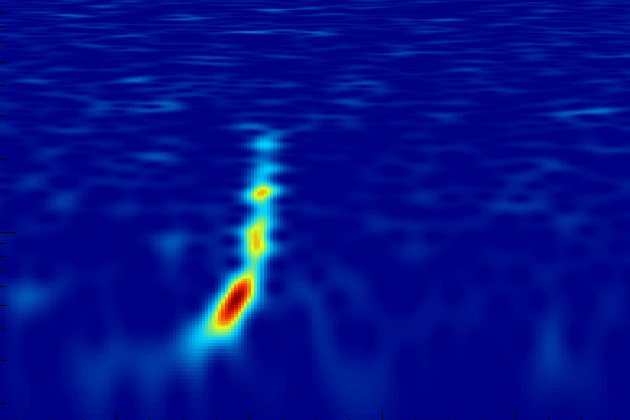
GW150914 time-frequency map in Hanford data, copied from the public cWB site.
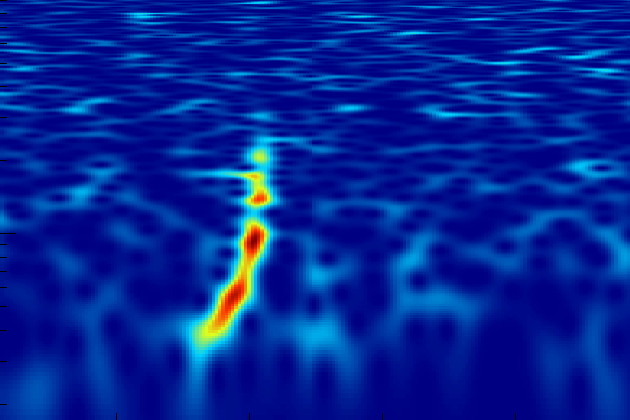
GW150914 time-frequency map in Livingston data, copied from the public cWB site.
Useful public links:
GW190521
GW190521 is a public example where cWB reconstruction is useful for visualizing a short, high-mass binary black-hole signal and its time-frequency structure.
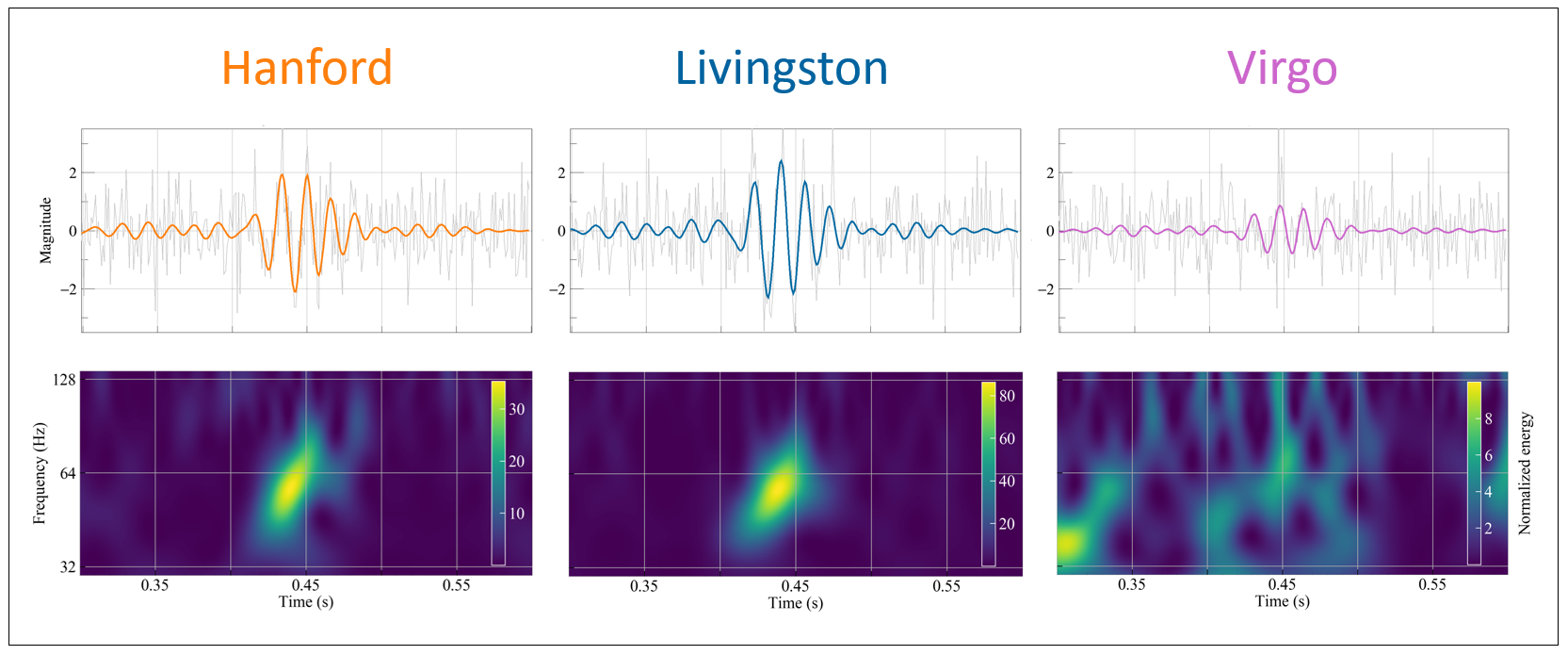
GW190521 public cWB display copied from the public cWB site.
Useful public links:
GW190814
The public cWB material also points to cWB contributions to higher-order-mode studies of GW190814. In the pycWB docs, use this mainly as scientific context: the mechanics of configuring searches, running jobs, and postproduction are covered by the current pycWB guides.
Useful public links:
Mapping cWB Concepts to pycWB
cWB concept |
pycWB location |
Notes |
|---|---|---|
|
pycWB uses YAML configuration rather than ROOT macros. |
|
|
Treat this as a ROOT/C++ cWB command. pycWB has separate GWOSC helpers
and normal searches run through |
|
Wavelet transform, pixels, clusters, likelihood |
These pages explain how pycWB implements the same cWB/cWB-2G algorithmic stages in the current Python workflow. |
|
CED event displays |
Public CED pages remain useful references. pycWB output is organized around Parquet catalogs, trigger files, plots, and postproduction reports. |
|
GWTC cWB waveform reconstructions |
Keep the public reports external and use the pycWB docs as a guide to current workflows. |
|
ROOT/C++ implementation details |
Some ROOT-backed modules are retained for interoperability or comparison, while native pycWB modules are the preferred path for new development. |
Where to Go Next
Use Start Here for a first pycWB run.
Use Pipeline Lifecycle to understand the current pipeline stages.
Use Module Overview to find the Python modules corresponding to cWB components.
Use Public GWTC cWB References to find public GWTC cWB reconstruction and CED links.